
Reading Criminal History Checks
Start with the record maker. Reading Police holds its incident and arrest reports, Pennsylvania courts hold filed dockets, and Berks County holds booking and jail information. No one source is a complete Reading criminal history. This order also improves the chance of finding a new event before every office has exchanged data.
- Call Reading Police Records at 610-655-6054 to confirm that it holds the city report.
- Use the city Right-to-Know route for a written police-record request.
- Search the UJS Web Portal for Berks MDJ and Common Pleas dockets.
- Check Berks Jail for current custody or call Booking at 610-208-4800, extensions 4837 or 4838.
- Use PATCH for a Pennsylvania repository name check or SP 4-170 to inspect your own full state record.
Reading Police Request Route
Formal Reading police requests go through the City Law Department in Room 2-54 at 815 Washington Street. The form asks for the requester name and address, a detailed description, a department choice, and whether inspection, copies, or certification is sought. Phone and email are recommended so staff can clarify a narrow request.
Submit by hand or mail, fax to 610-557-8266, or email Solicitor@readingpa.gov. Include a date, location, report number, and involved names when known. The city charges $0.25 per page and $5 for certification. Media, special documents, and postage cost the actual amount, and a 50 percent prepayment may apply when an estimate exceeds $100.
A good description identifies the Reading department, the event date or date range, the street or place, and the exact item sought. Choose inspection when the file size is unclear. Ask for certification only when an official use calls for it. The form also lets a requester choose paper copies, inspection, or both. A broad demand for every police record linked to a common name can be hard to identify and may sweep in exempt investigative material. A focused request for a known incident gives the Law Department a much clearer path to the responsive city file.
Records at Reading Police
Reading Police works from 815 Washington Street. Records has a direct line at 610-655-6054. The nonemergency desk sergeant is 610-655-6116, Criminal Investigations is 610-655-6246, and the Spanish hotline is 610-655-6292. Records staff address existing files; a current police need belongs with dispatch or the desk sergeant.
A Reading police file may contain a narrative, involved parties, location, alleged offenses, officer action, and evidence references. It is not a court docket. Investigative material and protected personal data may be withheld or redacted, even when a basic blotter entry or other part of a report is public.
Use the incident number when police supplied one. It is a city identifier, not the same as a UJS docket number or Pennsylvania Offense Tracking Number. This distinction matters when a Reading case has moved through several systems. Records staff can search the police file by its own reference, while a court clerk works from the docket. If the desired item is a crash report, first confirm the specific police crash process instead of assuming the general Right-to-Know route is the fastest or correct channel.
The Reading Police contact page is the source for the direct records and language-access numbers shown above.
The direct list helps separate a routine Reading records call from dispatch or an active investigative contact.
Reading Police Language Access
The Spanish police hotline at 610-655-6292 is a distinct city channel. A reader seeking an existing Reading report can still begin with Records, while the Spanish line can help when the issue concerns police communication rather than a court copy. TDD service is available at 610-655-6442.
Language access does not change which office holds the record. City police keep their report; the assigned MDJ and later Common Pleas court keep the dockets. State repository questions remain with PSP. Keeping that ownership clear prevents a caller from being sent through several unrelated offices.
Reading Court District Map
Reading has five magisterial districts, so the incident address matters. The county Reading MDJ map routes wards and streets to the right office. Districts 23-1-02, 23-1-03, 23-1-05, 23-2-01, and 23-3-09 share the city. Reading Central Court consolidates their preliminary hearings, while Central Arraignment Court handles after-hours emergency court work.
The official map is captured below for its role in Reading criminal record routing.
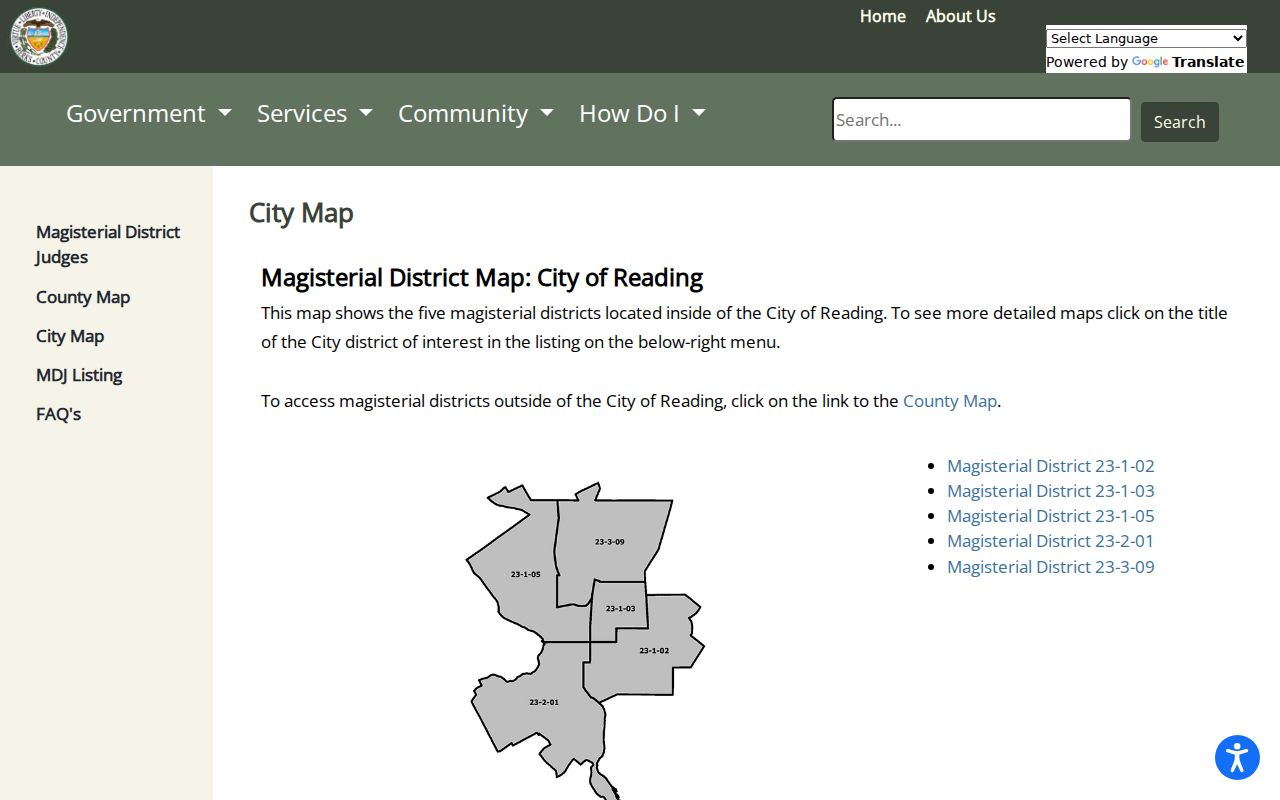
Use the map before calling a district office, then search both MDJ and Common Pleas levels when a case was held for court.
District 23-1-02 is at 1150 Muhlenberg Street. Districts 23-1-03 and 23-1-05 operate at the Services Center, 633 Court Street. District 23-2-01 is at 441 Morgantown Road, while 23-3-09 is at 2312 Fairmont Avenue, Suite 500. These locations are not interchangeable counters. A ward and address check is more reliable than choosing the nearest building. Once a misdemeanor or felony is held for court, search the Common Pleas docket as well because the later file receives its own docket number and adds pleas, motions, disposition, and sentence information.
Booking and Arrest Records in Reading
Reading does not operate a separate searchable long-term city jail in the reviewed official sources. Berks County Sheriff Central Booking photographs and fingerprints people arrested by RPD, checks identity, and creates booking data. A person committed to custody is transported to Berks County Jail at 1287 County Welfare Road.
The RPD report describes the city event. Booking documents intake. The jail locator shows current custody, and the UJS docket shows filed charges and court outcomes. A blank result in one source does not erase a record held by another. Recent events may take time to reach the next system.
Central Booking also checks fingerprints through state and national identity systems and can connect the new booking to a prior identity record. That process is different from a public name search. The charges recorded at intake may later change after prosecutorial review. For a current custody question, the jail channel is the right source. For the legal outcome, return to the docket. For the officer narrative, request the Reading Police file. Keeping those questions apart reduces false matches and avoids reading an early allegation as a final judgment.
Reading Reports Versus Dockets
A Reading Police report focuses on what officers saw, collected, and alleged. A UJS docket focuses on the prosecution. It can show the docket number, charge sequence, statute and grade, bail, counsel, hearings, disposition, sentence, and costs. Public docket sheets may omit the complaint, evidence, and sensitive identifiers.
Charges may change after review. Compare the incident number, offense tracking number, dates, and names rather than treating booking charges as final. A dismissal, acquittal, withdrawn charge, or nolle prosequi is not a conviction. The final court disposition is the key result when Reading allegations moved into a filed case.
The UJS person search can be narrowed by first and last name, date of birth, participant role, Berks County, docket type, case category, status, and filing dates. Search both Criminal and Magisterial District Judge contexts where appropriate. A public docket commonly shows the filing date, judge, attorneys, bail, charge rows, event history, and sentence data. It may not provide the complaint, exhibits, or full evidence. For older paper material or a document missing online, contact the custodian court rather than asking Reading Police to reproduce the court file.
The Reading Municipal Court File
Reading has no city-operated municipal criminal court. Pennsylvania uses magisterial district judges. They hear summary traffic and nontraffic cases, issue warrants, conduct preliminary arraignments, set bail, and hold preliminary hearings. Misdemeanor and felony cases held for court move to Berks Common Pleas.
| Court Name | One of five Reading MDJs, then Berks Common Pleas if held for court |
|---|---|
| Case Types Heard | Summary and traffic matters; preliminary stages of misdemeanor and felony cases |
| Case Lookup Channel | Free UJS search; paper or complex requests to the custodian court |
| What the Docket Shows | Charges, bail, events, status, disposition, sentence, counsel, and costs |
| Copies & Fees | Confirm current copy and certification charges with the court |
How Reading Records Reach the County
Reading Police creates the report. Central Booking creates the intake record. A complaint begins before an MDJ, and a case held for court moves to Common Pleas. The Clerk of Courts maintains that criminal file. Dispositions should later reach the Pennsylvania State Police repository.
Record flow: Reading PD › Berks County Courts › Pennsylvania State Police Central Repository
Use RPD for the narrative, booking channels for current custody, UJS for case events, and PATCH for the statewide result. The Berks County criminal history overview explains the county and state layers in more depth.
PATCH costs $22 for a standard Pennsylvania name check. It compares identifying data with PSP Central Repository information, not federal or out-of-state repositories. A “Request Under Review” result means PSP is checking a possible match by hand; it does not prove a record exists. Someone reviewing their own full Pennsylvania record uses the mail-only SP 4-170 Access and Review process instead. That fuller product includes convictions and non-convictions and is better suited to finding a missing or mismatched disposition.
Reading Police Data in Context
A June 2025 City Council presentation said Reading Part A crime fell 21 percent during 2024 and first-quarter 2025 overall crime fell 32 percent. It also reported narcotics investigations, weapons seizures, and enforcement totals. These are department-reported trends, not proof about a person or a block.
The official Reading website also announced a new RPD crime-charting system. Maps and city reports help explain broad police work. They do not show the final outcome of a named case, which belongs in the court docket.
The city source should be paired with UJS when a published police event became a prosecution.
Reading Record Access Rules
The Pennsylvania Right-to-Know Law governs many city agency requests, but it does not replace court policy. Reading may redact sensitive identifiers and withhold exempt investigative material. Court files follow UJS rules. Juvenile files, sealed matters, victim and witness identities, unexecuted warrants, medical information, and some financial data can be restricted.
Key Statutes:
Pennsylvania Right-to-Know Law sets agency request, exemption, response, and appeal rules.
18 Pa.C.S. § 9121 controls criminal-history dissemination and limited-access information.
UJS Public Access Policy controls open court files, sealed records, confidential data, and remote limits.
Ask Reading for the police file and the court for its docket. Neither office must create a combined criminal history that it does not maintain.
Reading Records Across a Historic City
Reading was laid out in 1748 and incorporated as a city in 1847. Its rail and industrial past shaped a dense municipal core that now places City Hall and police at 815 Washington Street near county justice offices at 633 Court Street. Physical closeness does not merge their records.
The Pagoda offers a useful local symbol. Built in the early twentieth century and later donated to Reading, it appears on the RPD shoulder patch. That city identity belongs to the police record, while the legal outcome still belongs to the county court. Older historical research may also require archives rather than current police or docket systems.